Country

  • 1-647-962-8213
  • Log in
  • Cart (0)
  • Checkout
  • Home
  • Custom Order 
    • Custom Designed Ties
    • Logo & Seal Design
  • Shop by Product 
    • What's New?
    • Masonic Watch 
      • The Matrix | Black Mother of Pearl
      • The Gethsemane | Olive Wood
    • Neckties, Bowties, Pocket Squares
    • Flags
    • Rings
    • T-Shirts
    • Posters
    • Hoodies
    • Embroidered Polo
    • Mugs
  • Articles
  • About
  • Contact
  • Country

  • Home
  • Custom Order 
    • Custom Designed Ties
    • Logo & Seal Design
  • Shop by Product 
    • What's New?
    • Masonic Watch 
      • The Matrix | Black Mother of Pearl
      • The Gethsemane | Olive Wood
    • Neckties, Bowties, Pocket Squares
    • Flags
    • Rings
    • T-Shirts
    • Posters
    • Hoodies
    • Embroidered Polo
    • Mugs
  • Articles
  • About
  • Contact
  • Country

The tie that binds

Top 10 Facts About Freemasonry According to AI

November 14, 2025

As someone who has spent most of my life inside the Craft, I already have my own answers to the question of what Freemasonry is and what it teaches. But we now live in a time when many people form their first impressions through AI tools instead of books, mentors, or real conversations. Because of that, I wanted to see how AI itself explains the fraternity. So I asked a simple question: “What are the top ten things you know about the Freemasons?” The response was clear, surprisingly accurate in many places, and worth sharing.

1. Freemasonry Is the World’s Oldest Fraternal Organization

The modern form of Freemasonry began in 1717 with the creation of the first Grand Lodge in London. Its symbolic roots go back to medieval stonemasons’ guilds and to biblical narratives that were used to teach moral lessons. Few organizations today can claim a lineage this old or a system this consistent.

2. It Teaches Through Symbols, Not Dogma

The Square, the Compasses, the Level, and the Plumb are not decorations. They are philosophical tools used to teach integrity, self-discipline, justice, temperance, and moral balance. Freemasonry does not prescribe beliefs. It uses symbolism to encourage personal reflection and growth.

3. Belief in a Supreme Being Is Traditionally Required

Most Masonic jurisdictions require belief in a Supreme Being but do not define which one. Freemasonry is not tied to a denomination. Christians, Jews, Muslims, Sikhs, and others meet together in lodge. Some jurisdictions, such as the Grand Orient of France, have removed this requirement entirely, showing that Masonry adapts to different philosophical climates.

4. Freemasonry Is Not a Religion

Many people misunderstand this point, but Freemasonry is not a religion and does not offer a system of salvation. Religious and political discussions are prohibited inside the lodge to prevent division. Instead, each man is encouraged to follow the dictates of his own conscience and faith.

5. Masons Advance Through Degrees

Freemasonry is structured into three degrees: Entered Apprentice, which represents the beginning of the journey; Fellowcraft, which emphasizes learning and the seven Liberal Arts and Sciences; and Master Mason, which represents maturity and the completion of the foundational teachings. This progression reflects the development of a person from innocence to knowledge and then to responsibility.

6. Secrecy Is Mostly Ceremonial

Many outsiders imagine Masonic secrecy as hidden information about world events. In reality, the secrets consist of grips, passwords, and ritual elements preserved from medieval operative stonemasons. The deeper secrets are internal. They include self-mastery, discipline, brotherhood, and personal responsibility. These lessons cannot be leaked because they must be lived and practiced.

7. Masons Have Shaped History

Operative stonemasons built the great cathedrals of Europe. Later, speculative Freemasons played major roles in the intellectual and political developments of the Enlightenment. Notable Freemasons include George Washington, Benjamin Franklin, Voltaire, Simón Bolívar, and Mozart. These individuals were drawn to the principles of reason, liberty, and moral duty that Freemasonry promotes.

8. The Focus Is Self-Improvement

Freemasonry asks every member to improve himself. This includes building character, serving others, cultivating knowledge, and strengthening the community. It is one of the earliest and most organized systems of personal development in the Western world, long before the idea of “self-help” became common.

9. Conspiracy Theories Follow Freemasonry Everywhere

Because Freemasons are discreet, use symbolism, and have a long and influential history, conspiracy theories have surrounded the Craft for centuries. Most of these myths come from political attacks in the nineteenth century, religious fundamentalism, and now social media. The truth is much simpler. Freemasonry survives because the work it teaches is timeless and practical.

10. The Mission Is Simple: Make Good Men Better

This is the core purpose of the Craft. Freemasonry does not exist to control governments or to hide secret knowledge. It exists to help good men refine their character, strengthen their moral compass, live with integrity, and build better families and communities. It focuses on inner transformation that becomes visible through consistent action in daily life.

About the Author:
John Paul Gomez is a DeMolay alumnus, four-time Worshipful Master, two-time Immediate Past Master, and the current Secretary of his lodge. A researcher, designer, and speaker, he blends historical insight with modern creativity through his brand FraternalTies, producing original Masonic regalia, artwork, and educational content for lodges worldwide.


Continue Reading

It’s Happening: Why 2024 Feels Like 1984

November 16, 2024

In George Orwell’s 1984, the world is controlled by an omnipresent, unfeeling entity that monitors every thought, every word, and every action.

While Orwell’s dystopia once felt like a distant nightmare, 2024 has brought us closer to its unsettling reality. The rise of artificial intelligence (AI) has introduced tools that simplify our lives but quietly redefine how we think, speak, and express ourselves.

The Hidden Risk of AI

AI is everywhere. It drafts emails, suggests headlines, and finishes our sentences. Each time AI “polishes” your words, it subtly nudges your thoughts into patterns it deems efficient and rational, but often devoid of human nuance. Over time, this influence risks creating a newspeak of AI-approved language, thus narrowing our ability to express original ideas and fostering conformity.

Why It Matters

“In the beginning was the Word, and the Word was with God, and the Word was God.” (John 1:1) Words are sacred—they are the foundation of creation, connection, and thought. Without words, there is no expression of ideas, no reflection of self, no sharing of truths. Philosophically, language is the bridge between thought and reality, enabling us to shape the world around us and ourselves in return.

Allowing AI to subtly shape our language risks surrendering that power. It becomes easier to communicate with polished efficiency but harder to think deeply, question boldly, or create freely. If we lose the richness of our language, we risk losing the richness of our humanity.

2024: A Defining Moment

2024 is drawing to a close marking a year of profound change: a pivotal US election, Elon Musk’s growing influence on global conversations—underscored by his recent appointment to lead the newly formed Department of Government Efficiency (or simply DOGE, of course)—and intensifying debates within the AI sphere about trust, transparency, and accountability. These events aren’t just headlines; they underscore the urgent need for us to actively shape how we think and express ourselves. This is a defining moment, not a fleeting trend.

What You Can Do

AI is a tool, not a master. To ensure it serves your voice, not defines it, use it thoughtfully—question it, challenge it, and maintain ownership of your thoughts. Understanding how AI shapes language is the first step to preserving individuality.

Reclaim your voice by joining groups that celebrate spoken and original expression. Organizations like Toastmasters provide a platform to refine your public speaking and communicate ideas with clarity and authenticity. Similarly, Freemasonry fosters deep thought and dialogue, where the spoken word is revered as a powerful tool for connection and self-expression.

This movement needs your support. By purchasing an item from our 1984/2024 Collection, you’re not just acquiring a product—you’re fueling the fight to keep humanity at the center of innovation. This isn’t charity—it’s my livelihood. Every purchase sustains this effort to spark critical conversations, protect individuality, and inspire a future where creativity, authenticity, and human connection thrive.

As we move into 2025 and beyond, let’s ensure innovation uplifts humanity, not controls it. Together, we can secure a future where our words remain our own and our voices, uniquely human.

This is #TheTieThatBinds.

Continue Reading

The Truth Behind the 5 Biggest Lies About Freemasonry

September 10, 2024

As a Christian Freemason, I’ve encountered a slew of wild accusations about Freemasonry—mostly from fellow Christians. It’s disheartening to see how much confusion persists, particularly among those who rely on incomplete or outdated sources rather than engaging directly with accurate information. I’ve used the term "moròns" (yes, with an accent) not out of malice, but to jolt them into recognizing the absurdity of these claims. Shock tactics can be effective for challenging deeply ingrained misconceptions, much like how being called out by an elder in my youth, though painful, ultimately helped me grow. Let’s address the five biggest misconceptions about Freemasonry:

1. Freemasons worship Satan.

Fact: Freemasonry isn’t a religion. It doesn’t offer salvation—that’s between you and God. Members are required to believe in a Supreme Deity, but Satan? Absolutely not. Satanists don’t worship Satan like people think; for them, Satan represents opposition, and most Satanists are actually atheists. Since atheists don’t believe in a Supreme Being, they can’t be Freemasons*.
(*In some jurisdictions, like the Grand Orient of France, atheists are accepted, but that’s not the case in most.)

2. Freemasons sacrifice children.

Fact: This one’s as absurd as it sounds. Freemasons can’t be convicted felons, and child sacrifice? That’s pure fiction, dating back to ancient myths about Moloch, but modern fearmongers have blown it out of proportion. Freemasons are focused on community service and personal growth—not the stuff of horror movies.

3. Freemasons are anti-Christian.

Fact: The majority of Freemasons are Christians. Freemasonry places the Bible—the Great Light—at the center of its rituals. Members take personal oaths on the Bible, but not to commit to anything sinister. These oaths are about self-improvement: bettering yourself every day, in every way. The values Freemasons strive for—charity, integrity, kindness—are deeply aligned with Christian teachings. If we’re anti-Christian, we’re doing a terrible job of showing it, considering the Bible is central to everything we do.

4. Freemasons control the government/world affairs.

Fact: If Freemasons ran the world, you’d think we’d at least get our Lodge meetings to start on time. Yes, there have been influential Freemasons throughout history—presidents, politicians, inventors—but that’s because Freemasonry attracts ambitious, thoughtful individuals who care about personal growth, tradition, and community service. We love the rigidity of ritual and preserving tradition, but world domination? That’s a stretch.

5. Freemasons worship idols or pagan symbols.

Fact: Symbols like the Square and Compasses are tools for teaching, not for worship. They help members learn about fairness, integrity, and good character. And if you’re concerned about pagan symbols, you might want to take a second look at the days of the week. Monday for the moon god, Thursday for Thor, and Saturday for Saturn. Yep, you’ve been unknowingly living in a pagan worship calendar this whole time. Relax, though—we’re not here to judge.


Why do these myths persist? Because people love to be afraid. It’s the same reason we pay to see horror movies or ride rollercoasters. Fear is exciting, but the truth about Freemasonry is much more grounded: it’s about personal growth, community service, and living by a moral code. Let’s be real—the truth is way more interesting than these wild conspiracy theories.


 About the Author

Authored by Brother J. Paul Gomez, a devoted father of four, Senior DeMolay, Past Master, and Christian, this piece reflects my personal insights and experiences. My perspective is shaped by my journey and understanding within both Freemasonry and my faith.

Disclaimer

The views expressed in this writing are solely those of the author and do not represent the official stance of my lodge, my grand lodge, or Freemasonry as a whole. The intent is to provide a personal perspective and stimulate thoughtful discussion rather than to speak on behalf of the broader Masonic community.

Continue Reading

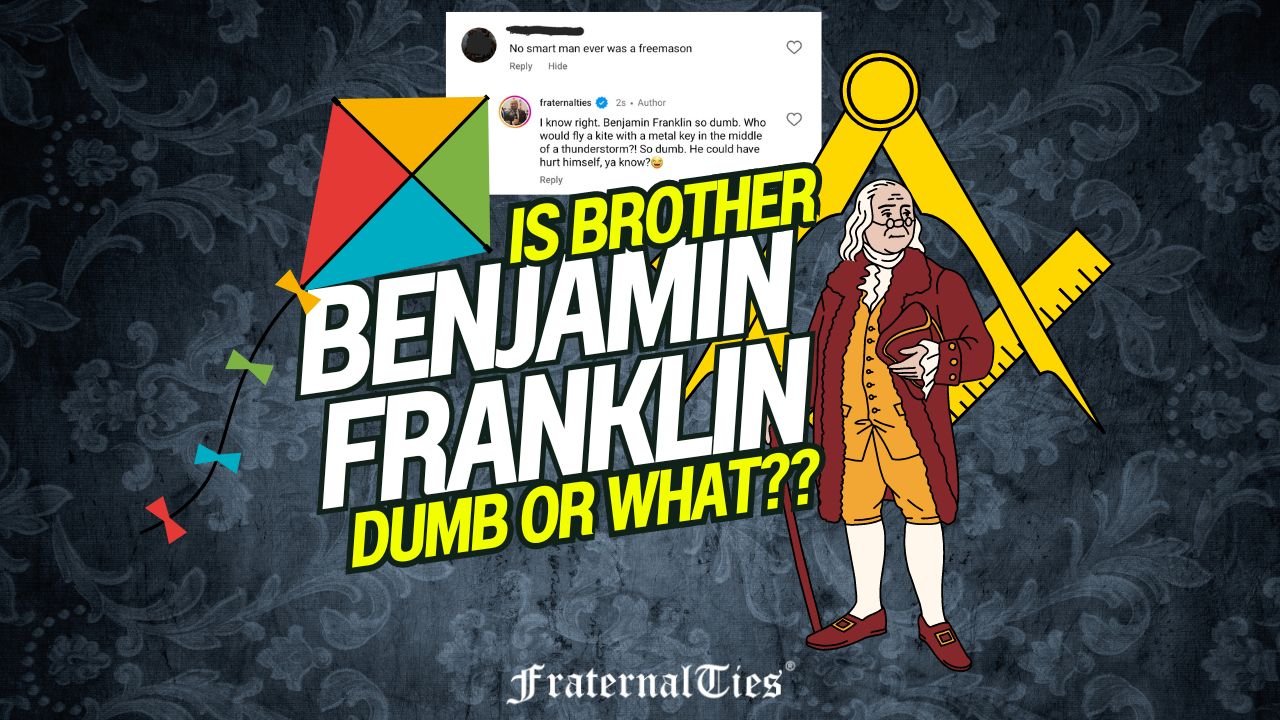
Are Freemasons Dumb?

April 26, 2024

One of the more absurd accusations levied against Freemasons in online forums is the claim that they are intellectually deficient. This baseless accusation stems from the misguided belief that high-level Freemasons engage in occult practices and conspire to bring about chaos and suffering in the world. Skeptics wonder if Freemasons are indeed naive, as they perceive themselves to be enlightened about the so-called 'truth' while Freemasons remain oblivious.

While occasional banter can be entertaining, the purpose of this blog post is not to engage in frivolous exchanges. Instead, it aims to showcase the timeless wisdom possessed by some of our Masonic Brothers.

In today's fast-paced world, filled with myriad challenges and constant distractions, navigating life can be overwhelming. In such times, we can turn to the timeless wisdom of Brother Benjamin Franklin, a polymath whose legacy continues to inspire generations. As a distinguished member of the Lodge of Nine Muses, also known as the Tun Tavern Lodge, Franklin's insights resonate deeply with the ethos of Freemasonry, embodying principles of industry, wisdom, and resilience.


Tip 1: 'Early to bed and early to rise, makes a man healthy, wealthy, and wise.'

Numerous studies have shown that adhering to a natural circadian rhythm, aligning sleep patterns with the day-night cycle, promotes optimal health and cognitive function. Prioritizing restorative sleep is essential for physical vitality and mental acuity.


Tip 2: 'Conquer Your Vices, Cultivate Your Virtues.'

Stoic philosophy emphasizes the importance of mastering one's impulses and nurturing virtuous qualities. By practicing self-discipline and moral excellence, individuals can overcome destructive habits and cultivate inner strength, enabling them to weather life's storms with resilience.


Tip 3: 'Never leave that till tomorrow which you can do today.'

Procrastination often hinders productivity and personal development. Addressing tasks promptly and efficiently helps reduce stress and maintain a sense of control over responsibilities. Embracing a proactive mindset empowers individuals to seize opportunities and unleash their full potential.


Bonus Tip: 'Do not anticipate trouble, or worry about what may never happen. Keep in the sunlight.'

Maintaining a positive outlook and refraining from unnecessary worry are essential for mental well-being. By focusing on the present moment and fostering optimism, individuals can navigate life's challenges with grace and resilience, approaching each day with renewed energy and enthusiasm.

Incorporating these pearls of wisdom into our daily lives enables us to cultivate balance and tranquility, even amid life's chaos. Let Franklin's sage counsel serve as a guiding light, illuminating our path toward inner peace and fulfillment.

Continue Reading

Interested in Joining Freemasonry? Know the Status in Your Country

April 23, 2024

If you're considering joining Freemasonry but live in a country where the government maintains tight control over civic institutions, it's essential to understand that Freemasonry is often not permitted to operate within such authoritative domains. There may be individuals attempting to recruit you, but it's crucial to be cautious (trust your instincts). If this sounds familiar, read on.

Below is a categorized list of countries where Freemasonry is either not officially recognized or banned. Seeking Masonic membership from these countries could get you frowned upon, fined, jailed, or worse.

Asia:

  • China: Freemasonry is officially banned in China, and any Masonic activity is prohibited.
  • Iran: Freemasonry is not officially recognized, and its practice is banned in Iran.
  • Saudi Arabia: Freemasonry is prohibited in Saudi Arabia, and there are strict penalties for engaging in Masonic activities.
  • Qatar: Freemasonry is not officially recognized, and its practice is restricted in Qatar.
  • United Arab Emirates (UAE): Freemasonry is not officially recognized, and its practice is restricted in the UAE.
  • North Korea: Freemasonry is banned in North Korea, and any form of secret society or organization is heavily restricted.
  • Turkmenistan: Freemasonry is not officially recognized, and its practice is banned in Turkmenistan.
  • Tajikistan: Freemasonry is banned in Tajikistan, and there are no Masonic lodges in the country.
  • Uzbekistan: Freemasonry is not officially recognized, and its practice is banned in Uzbekistan.
  • Vietnam: Freemasonry is not officially recognized, and its practice is restricted in Vietnam.
  • Indonesia: Freemasonry is not officially recognized, and its practice is restricted.

Africa:

  • Egypt: Freemasonry is banned in Egypt, and there are no Masonic lodges operating openly in the country.
  • Morocco: Freemasonry is not officially recognized, and its practice is restricted in Morocco.
  • Algeria: Freemasonry is banned in Algeria, and any Masonic activity is prohibited.
  • Tunisia: Freemasonry is not officially recognized, and its practice is restricted in Tunisia.
  • Libya: Freemasonry is banned in Libya, and there are no Masonic lodges operating openly in the country.
  • Sudan: Freemasonry is not officially recognized, and its practice is restricted in Sudan.
  • Eritrea: Freemasonry is banned in Eritrea, and any form of secret society or organization is heavily restricted.
  • Ethiopia: Freemasonry is not officially recognized, and its practice is restricted in Ethiopia.
  • Somalia: Freemasonry is banned in Somalia, and any form of secret society or organization is heavily restricted.
  • Gambia: Freemasonry is not officially recognized, and its practice is restricted in Gambia.

Europe:

  • Russia: Freemasonry faced persecution and was banned during the Soviet era. While it's not explicitly banned today, Freemasonry still faces challenges and is not widely practiced openly.
  • Turkey: Freemasonry is not officially recognized, and its practice is restricted in Turkey.
  • Belarus: Freemasonry is not officially recognized, and its practice is restricted in Belarus.
  • Azerbaijan: Freemasonry is not officially recognized, and its practice is restricted in Azerbaijan.
  • Armenia: Freemasonry is not officially recognized, and its practice is restricted in Armenia.
  • Kyrgyzstan: Freemasonry is not officially recognized, and its practice is restricted in Kyrgyzstan.
  • Kazakhstan: Freemasonry is not officially recognized, and its practice is restricted in Kazakhstan.
  • Bosnia and Herzegovina: Freemasonry is not officially recognized, and its practice is restricted in Bosnia and Herzegovina.

Verification and Conclusion:
Things and perceptions can change, so it's important to verify the status of Freemasonry in your country. You can use resources like the list of Foreign Grand Lodges compiled by the United Grand Lodge of England. Stay informed, stay vigilant, and feel free to comment below if you think something is not accurate.


Continue Reading

Does Masonry Make Good Men Better?

March 26, 2024

There's a saying among Masons that goes, "Freemasonry makes good men better," but not too many talks about is that it exposes the bad apples and merceneries for who they are. And because the world of Freemasonry is small — everyone knows everyone, a word can travel fast.

Continue Reading

1 2 3 … 22 Next
Important Links
  • Blog
  • About us
  • Contact us
  • Rewards Program
Sign up for our newsletter

Sign up to get the latest on sales, new releases and more…

About FraternalTies


FraternalTies® is a Freemasonry-inspired brand and movement led by graphics designer John Paul “JPG” Gomez.


  • Terms of Service
  • Shipping Policy
  • Privacy Policy
  • Refund Policy

Country

© 2025 FraternalTies. Ecommerce Software by Shopify

American Express Diners Club Discover Mastercard PayPal Shop Pay Visa